The Real Problems Slowing Translation at Scale
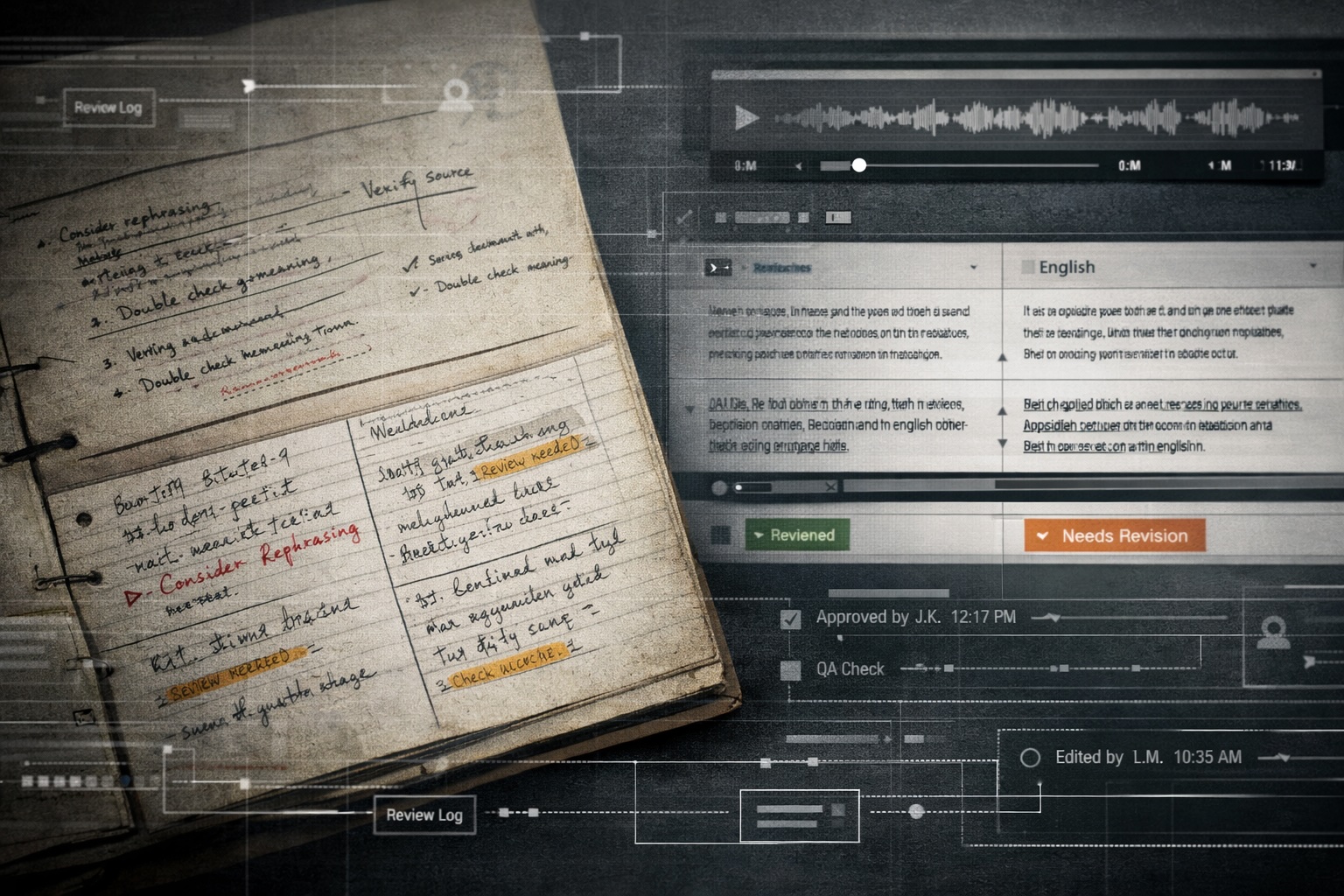
At Frontier R&D, the hardest problems we are working on are not technical in the narrow sense. Modern AI already translates text competently. The real obstacles lie elsewhere, and they are the reason translation—especially high-stakes translation—has remained slow, expensive, and institutionally fragile.
Our work on the Codex Translation Editor exists to address those deeper constraints.
The first problem is legitimacy at scale. Translation is not just about producing words; it is about who is authorized to stand behind them. In domains like Bible translation, legal translation, or sensitive media, the question is never "can this be translated?" but "who is responsible when this translation is disputed, revised, or published?" Existing systems solve this by slowing everything down and concentrating authority in a few bottlenecks. AI breaks that model by making production fast. The unresolved question is how authority, responsibility, and trust function when speed is no longer scarce.
Closely related is the problem of quality signaling. High-quality drafts can now be produced quickly, but institutions still rely on opaque, labor-intensive review processes to judge whether a translation is acceptable. That makes quality real but illegible. What's missing are clear, inspectable signals of confidence, provenance, revision history, and comparative consistency across large projects. Without those signals, fast translation remains socially risky, no matter how good it actually is.
Another core issue is accountability. Traditional workflows implicitly assume that humans are the only accountable agents. AI complicates this assumption without replacing it. If an AI-assisted workflow introduces an error, responsibility cannot be waved away—but neither can it be assigned as if nothing has changed. We are working toward systems where accountability is distributed but explicit: every change traceable, every decision reviewable, every claim grounded in evidence rather than reputation alone.
Then there is the economic problem. Grant funding is excellent for innovation and experimentation, but it is a poor foundation for infrastructure. Translation platforms that matter must be reliable, boring, well-supported, and maintained over long horizons. That requires aligned incentives. A sustainable commercial model is not a betrayal of nonprofit goals; it is what allows those goals to be supported deliberately rather than precariously. Without a commercial backbone, critical tools either stagnate or become politicized.
There is also a positioning problem in the broader market. Codex is not "just another translation tool." It is a system for managing complex, multimodal, AI-assisted workflows where quality and responsibility matter. That makes it applicable far beyond Bible translation—but it also means we must be disciplined about what we promise and to whom. Generality without clarity leads to slow adoption and confused expectations.
Finally, there is the transition from founder-led success to system-level reliability. Early tools work because their creators understand them deeply. Mature tools work even when users misunderstand them, push them into edge cases, or misuse them. Solving that problem requires constraints, defaults, and guardrails that encode hard-won experience into the product itself.
In short, the problem we are solving is not how to translate faster. It is how to make speed, quality, authority, and responsibility coexist without collapsing back into legacy bottlenecks.
If that problem is solved, translation at scale stops being an institutional liability and becomes shared infrastructure. That is the future we are building toward at Frontier R&D.